Australian house prices are falling again, and it has been making plenty of headlines. With so much household wealth tied up in property, we wanted to share how our Investment Committee sees it, and what it means for the Derwent Portfolios.
Small falls are normal
Since the early 1980s, national house prices have fallen by more than 5% seven times, and those falls have normally topped out at around 10%.
Over the same period the median home has risen around 16-fold, while household income after tax has only risen around eight-fold. Interest rates have come down, but nowhere near enough to make up the difference, which is why first home buyers today spend more of their income on a home, for longer, than any generation before them.
Past falls have usually come from the same few causes: rising interest rates that make borrowing more expensive, tighter lending rules that limit how much people can borrow, and a weaker economy pushing unemployment up. The 2022 fall followed the sharpest run of rate rises in decades. Tighter lending rules between 2015 and 2017 took prices around 9% lower, and the early 1990s recession took prices only 6% lower, even though unemployment rose by more than five percentage points.
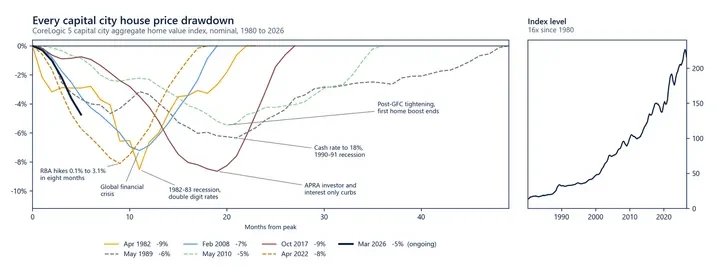
Source: CoreLogic via LSEG Datastream. Peak to full recovery in nominal terms.
What is driving this fall?
Two things: the Reserve Bank raising interest rates again, and the tax changes in the latest Budget, which limit negative gearing to newly built homes and replace the 50% capital gains tax discount with indexation and a 30% minimum tax on gains.
We expect the rate rises to have only a limited effect on prices. Markets expect a little more from the Reserve Bank, but that looks like fine tuning rather than an attempt to slow the economy sharply.
The Budget changes are the bigger question, and there are two views. Most of the research from the RBA, Treasury, the Grattan Institute and academic economists points to a modest effect, with prices around 1% to 4% lower than they would otherwise have been. The other view is that buying an established home as an investment makes little sense now, with gross rental yields under 3%, housing already very unaffordable, and losses no longer deductible against salary income.
That matters because investors borrow about as much each quarter as owner occupiers (excluding first home buyers), and around 80% of what they buy is established homes. If investors step back sharply, up to a third of home buying could disappear. That said, existing investors keep their current arrangements, so no one is being forced to sell. On balance we lean towards the research: there will be an impact, but it is too soon to say whether it will be bigger than past falls.
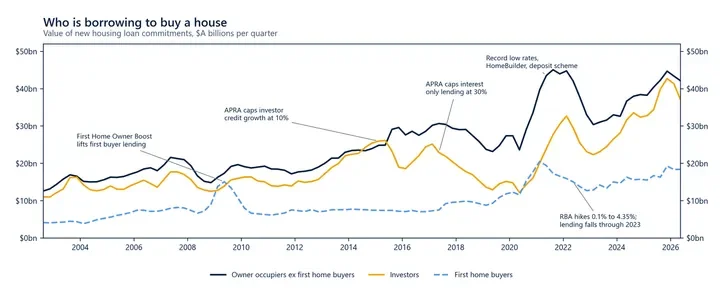
Source: ABS via LSEG Datastream. Value of new home loans; owner occupiers excludes first home buyers.
Why prices have held up
There are good reasons Australian prices have risen so far over the past fifty years, and why falls have stayed small. Interest rates generally fell between the 1990s and 2020 and mortgages got longer, so buyers could borrow more. Housing has also been treated generously: gains on the family home are tax free, and the home is exempt from the age pension means test.
Supply has not kept up either. A home now takes roughly twice as long to build as it did in the mid-1990s (though homes are bigger on average), approvals are slow and complex, and much of the land in our large cities is restricted in what can be built on it.
Since 2022, two things have held prices up despite higher interest rates. The cost of building a new home has risen by around 40% since 2021, lifting the value of every existing home. And strong overseas migration has meant far more new people than new homes, which pushes up both rents and prices. Australia has been badly short of new housing, relative to migration, since 2022.
What would it take for a big fall?
Housing is so important to the economy that a large fall would weaken household spending for some time. The government has a track record of supporting housing with home buyer and builder grants when the market or economy looks shaky, APRA can loosen lending standards at the government's request, and the Reserve Bank will cut rates if it sees substantial weakness hurting the economy. In our view, a substantial fall would have to be allowed, or caused, by policymakers.
That is not unheard of. Canadian prices have fallen around 20% since 2022. After interest rates rose there, the government cut its permanent migration program by around a quarter and let its number of temporary residents run down, and the population has actually shrunk. Prices have kept weakening even after 2.75 percentage points of interest rate cuts.
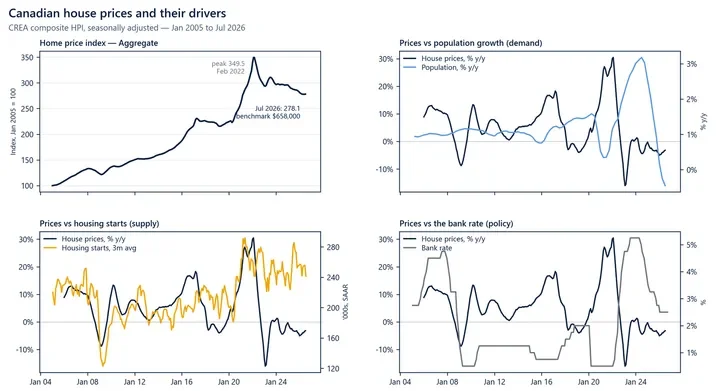
Source: CREA MLS® Home Price Index (seasonally adjusted), LSEG Datastream.
New Zealand is another example. Prices there are around 17% below their late-2021 peak, or roughly 30% lower after inflation, following sharp rate rises, a recession and a record number of New Zealanders leaving for Australia.
There are early signs of a similar push here. The NSW and Victorian governments are overriding local council planning to allow more homes in established suburbs, and pressure to reduce migration is building. More supply and less demand could add to the pressure on prices, beyond what the tax changes and higher interest rates are already doing. Even so, we think the risk of a very large fall is still low, given the levers available to support the market.
Portfolio Positioning
We think part of the reason productivity in the economy has been weak could be very unaffordable housing. Young people cannot afford to live close to where the productivity benefits of big cities are strongest, and household savings have gone into housing, which is an unproductive asset. So very high house prices are probably a drag on long term earnings growth. However, falling house prices discourage household spending, and are generally bad for the economy and company earnings in the short term.
Neither scenario is particularly attractive for Australian shares, and this Catch-22 is part of the reason the Derwent Portfolios currently hold less in Australian shares than their long-term target (an underweight position).